
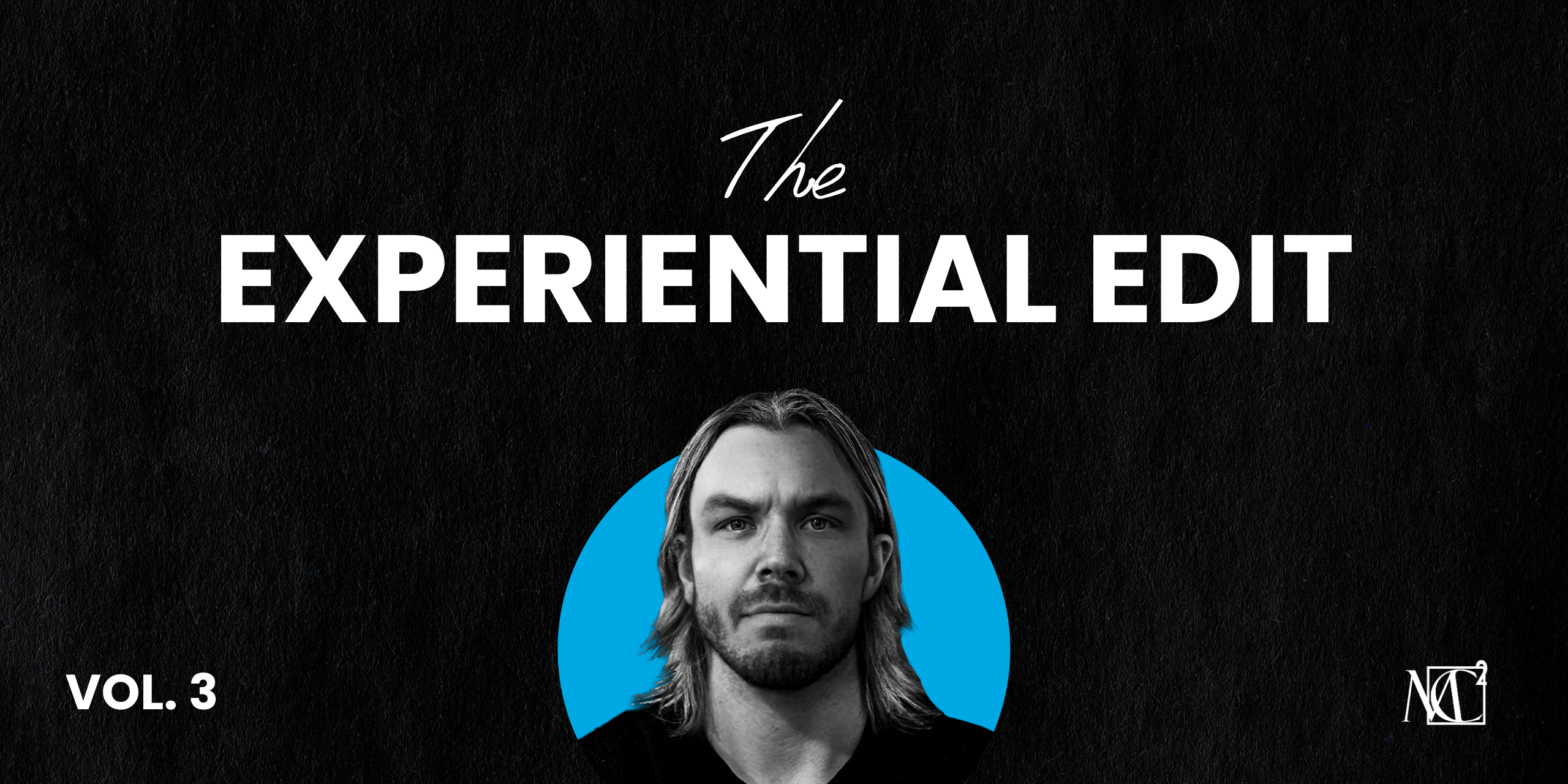
The Experiential Edit, Vol. 3: Simon Waloszek, Creative Director at MC²
As creative tools become more accessible and AI reshapes the industry, the role of the creative director is evolving; but the fundamentals remain the same. For Simon Waloszek, Creative Director at MC², great ideas are built on instinct, strategy, and a deep understanding of people.
In this edition of The Experiential Edit, Simon shares his perspective on experiential marketing, creative risk, AI, and why the most memorable brand experiences are the ones that make people feel something.
What is your role, and how would you describe it to someone outside the industry?
My role is Creative Director, and it spans nearly every aspect of the business; from storytelling, design, and art direction to digital, technology, 360 campaigns, and the entire creative process.
To someone outside the industry, I'd describe a creative director as someone who shapes ideas and makes sure they connect with people. I think that role is more important than ever because we live in a time when everyone has access to powerful creative tools. There has never been a moment where so many people could create so much, so quickly.
But access to tools doesn't automatically lead to great creativity. The real challenge is knowing which direction is right. It's about understanding whether an idea will resonate, not just with our clients, but with their audiences, customers, and the people they're trying to reach.
A big part of my role is finding the balance between instinct, strategy, craft, and experience. It's having the confidence to say, “This is the direction that can work,” knowing that instinct comes from years of understanding how creativity, brands, culture, and people interact in the real world.
You've worked across traditional advertising, digital, and experiential. What makes experiential marketing uniquely powerful today?
I think the most powerful thing about experiential marketing is that it creates an elevated conversation.
With above-the-line (ATL) and below-the-line (BTL) campaigns, you're usually speaking to a target audience that you believe will connect with the message. In experiential, though, you're often engaging with people who have already chosen to be there. They're interested in the industry, the product category, or the brand. They're attending the event or activation because they already have a level of curiosity and understanding.
That gives us the opportunity to elevate the conversation. We don't have to start from zero, we can go deeper. We can offer a more meaningful discussion, a more unique perspective, and a richer brand experience because we're speaking to an audience that already understands the fundamentals.
For me, that's what makes experiential marketing so powerful today. It allows brands to move beyond simply communicating a message and create moments where people can explore, question, and connect with the brand in a much more personal way.
What's the biggest misconception brands have about how people experience experiences?
I think the biggest misconception brands have is that everything about an experience can be measured.
They believe emotions can be measured, feelings can be measured, smiles can be measured, and every moment someone says “wow” can somehow be captured in data. Of course, data is important, we need it. But there's much more to an experience than what can be counted.
There's logic, and there's heart. The most important part is finding the right balance between the two.
We're moving into an era where metrics are everywhere, and many brands believe they can analyze every aspect of how people respond to an experience. I think that's a misconception. We need to leave room for humanity in what we do.
People aren't machines. We experience things in ways that can't always be measured, and that's part of what makes experiences so powerful. We should make space for that.
If brands start looking at everything only through numbers, what's the point of creating something unique? What's the point of finding solutions that make people genuinely curious, interested, moved, or emotionally connected to what they see and feel?
How is AI changing the role of the creative director?
AI is a tool, or rather, an incredible set of tools that helps us bring our vision to life faster.
That may sound like a simplification, but I think it's also the most realistic way to look at it. AI is incredibly important today, and not using it at some stage of the creative process is becoming almost impossible. It gives us the ability to visualize, test, and present ideas much faster than before.
I don't believe AI replaces the creative director. It doesn't create the vision for you, it helps you express the vision you already have. It allows you to communicate a concept more clearly, make it more compelling for the client, and, once the idea is approved, move more quickly into design, production, and execution.
For someone who has been in the industry for many years, AI is simply another tool in the creative toolkit—a very powerful and efficient one, but still a tool. It streamlines parts of the process and helps us explore creative directions faster.
At the same time, it's changing the creative landscape in a much bigger way. Today, it's easier than ever for anyone to produce something that looks creative or present themselves as a creative director. I actually think that's a good thing, because I don't believe there's such a thing as a bad idea.
How do you help clients take creative risks while remaining aligned with business goals?
I think it is all about how you tell the story, and how that story truly connects to the product, the brand, and the client’s business.
Every business has a different challenge, and every challenge requires a different solution. There are times when taking a creative risk is exactly what a brand needs, and there are also times when the smartest solution isn't necessarily the riskiest one.
Going completely risk-free can be dangerous, because you may end up creating something forgettable. But taking the biggest risk every time can be just as dangerous if the idea loses its connection to the business goal.
For me, it is about finding the right balance. It is about identifying that small window of opportunity where a risky idea can actually serve the strategy, elevate the story, and make the experience much more impactful and memorable.
The risk should never be there just for the sake of risk. It should be there because it helps the brand say something more clearly, more emotionally, or more powerfully.
What types of client challenges excite you most?
I think every client can be exciting because every client has a challenge, and every challenge has the potential to become something memorable.
For me, there's no such thing as a non-exciting brand, especially in the experiential space. If an experience isn't exciting in some way, it almost doesn't exist. It becomes invisible. The question isn't whether the client is exciting; it's where the opportunity lies to create excitement.
Of course, that excitement can take many forms. For one brand, it might be about emotion. For another, it could be innovation, education, entertainment, or creating an entirely new way for people to engage with the product.
I try to approach every client the same way: What is the unique opportunity here, and how can we bring it to life in a way that feels relevant, memorable, and valuable for their audience?
That's what excites me most: finding the hidden potential in a brand or business challenge and turning it into something people genuinely want to experience.
What project would you add to your career highlight reel?
Honestly, I would add all of them if I could.
For me, there's something meaningful in every project. There's always a challenge, a lesson, a collaboration, or a moment that stays with you. As creatives, I don't think it's only about which project you choose to highlight, it's also about how you want to be represented as a creative.
I've been lucky to work with amazing clients, talented teams, and incredible people across many different types of projects. That makes it difficult to point to just one and say, “This is the one.”
Every project has contributed to the way I think, the way I create, and the way I understand brands, people, and experiences. So if I could, I'd put every single one of them on my highlight reel.
For Simon, creativity isn't about chasing the next trend, it's about creating experiences that connect. Whether helping brands take calculated risks or uncovering new opportunities for engagement, his approach is grounded in the belief that the strongest ideas balance business strategy with human emotion. While technology will continue to shape how experiences are created, it's the emotional connection they inspire that makes them unforgettable.